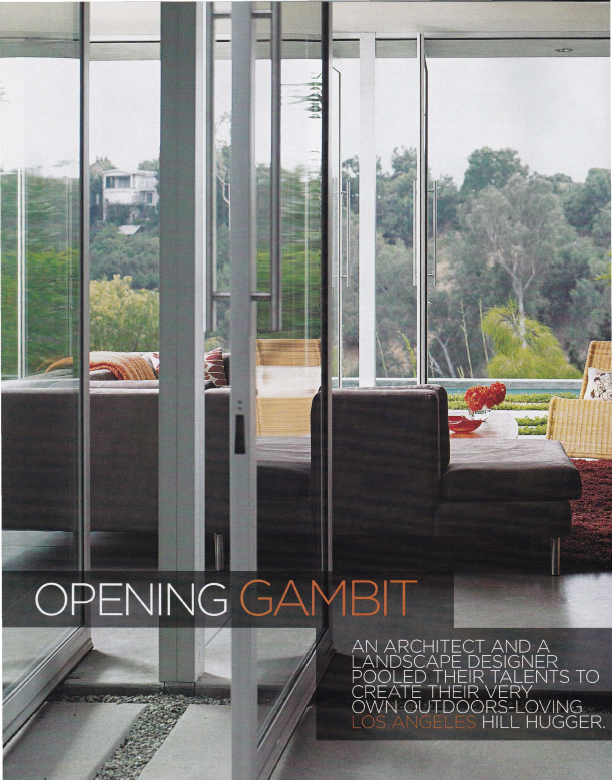
An Architect and a landscape designer pooled their talents to create their very own outdoors-loving Los Angeles Hill hugger.
Written by Katherine E. Nelson; produced by Laura Hull; photos by John Ellis
Originally published in Metropolitan Home magazine
“I wanted a house with city views,” says Michael Ferguson, “While my wife, Kathleen, wanted one that felt connected to the earth.” Michael, an architect and principal of Los Angeles-based Space International and Kathleen, a landscape designer who heads her own eponymous firm, had been looking for a place to build a home for themselves when they stumbled on a lot in the historic east-side residential neighborhood of Mount Washington. It offered killer canyon views and a giant pepper tree. The young couple (soon to be joined by baby son Cole) was sold.
The sloping site, however, wasn’t without its challenges. Density restrictions in the area meant that the Fergusons could build on only 5o percent of their 4,200-square-foot property. Their response was to develop a modest three-bedroom, two-bath plan that makes the most of outdoor space by linking the ground-floor rooms with a series of sunlit terraces. “The way the rooms open directly co the outside makes the house feel much bigger than it is on paper,” Michael says.
Inside the living, dining and kitchen spaces are combined into one lofty central room. Walls of floor-to-ceiling pivoting glass doors open into a front yard, where a shady pebble garden lies underneath the majestic pepper tree, and into a sunny backyard, where there’s a lawn and a lap pool. When the doors are open, the room feels like a cantilevered porch.“When we first moved in,” remembers Kathleen, “We had doves flying through the living room, and a family of squirrels upstairs keeping the electrician company.”
While the first floor exposes the living areas to the outside, the second floor, which houses the sleeping areas and bathrooms, has a more intimate feel. Instead of the dramatic pivot doors below, Michael arranged simple punch windows to offer privacy from the outside, views of the canyon from inside.
“After the house was framed,” says Michael,“I fine-tuned the window placement on site so we weren’t staring at a telephone pole or the neighbor’s air-conditioning unit.”
The upstairs embraces the home’s flowing layout—the master bedroom opens directly into a bathroom, which combines a walk-in closet, toilet, shower and bathtub into a single area. The home has few interior doors, like those between the bedrooms and the central stairwell. “We are a very open family, and we like that our design reflects that sense of sharing and openness, even in the more private areas of the house,” Michael says.
Because the Fergusons are self-employed designers, young parents and first-time homeowners, keeping a lid on expenses was important. To minimize costs, they took on all of the design work themselves and acted as contractors and crew. “We were there seven days a week until the wee hours,” says Kathleen.“We would be out on the patio on a Saturday night-still hammering!”
For the materials, Michael carefully selected lower-priced, off-the-shelf supplies, including concrete, birch plywood, drywall and plaster. “By using standard elements in an unconventional way, we were able to create an elegant design at an affordable price,” he says.
Low maintenance was also important to the young family, especially with the landscape design. Tough grasses, bamboo and shrubs made up the majority of plantings. For the lawn, Kathleen made an unlikely choice in laying down dichondra sod, which had been popular with 1950s modern homes.“It turned out to be the perfect choice,” Kathleen says.“I just trim it with a pair of scissors between the pavers. We never mow it.” A drip watering system also saves time because overhead spray doesn’t get on the building, a boon for a structure with so many windows.
Instead of planting grass in the forecourt, Kathleen opted for pebble mulch. It tidies up, she says, with just a quick raking before guests arrive. It has also proved to be one of young Cole’s favorite areas of the house.“He plays in it for hours just like a sandbox,” Kathleen says.
In all, construction of the home took about a year. While they admit that their design collaboration had stressful moments (“You could say that being your own client is a bit like giving yourself a frontal lobotomy,” Michael jokes), they’ve already begun working on a new project. To keep the creative energy flowing, they have started the design process all over again on another piece of property nearby. There’s one change to their approach: This time they’ve hired a general contractor so they can focus on making what Kathleen calls “the fun decisions.”
What the Pros Know
Artificial turf can be your friend—but not the Super Bowl-green kind of yesteryear. New technology and advanced color matching have resulted in artificial turf that is pleasant on the eye and toe-tickling to the touch. For Michael and Kathleen, artificial turf presented a fun, unconventional alternative to a wood deck.“It softened the modern edges of the space and was a great way to bring the green of the pepper tree foliage right to the edge of our bedroom,” Michael says.“It creates the illusion of sleeping outdoors.” Installation is easy: The turf rolls out like a rug. One thing to keep in mind: The fabric is designed to drain so leave room for water runoff. And Michael stresses that although artificial turf has great qualities such as low maintenance and drought resistance, it shouldn’t be viewed as a replacement for sod.“It should be used in places where its synthetic nature can be appreciated. I like to think of it more like an outdoor carpet than a lawn,” he says.
 katherine nelson journalist + editor
You must be logged in to post a comment.